




Why Can’t You Smell Your Own Scent? The Science Behind Fragrance Blindness
Have you ever sprayed your favorite perfume in the morning, enjoyed the fragrance for a few minutes, and then wondered where it went?
You check your clothes, smell your wrist, and barely notice anything. But then someone walks past you and says, “You smell amazing.”
So, what happened?
Your perfume probably did not disappear. Instead, your nose became accustomed to it.
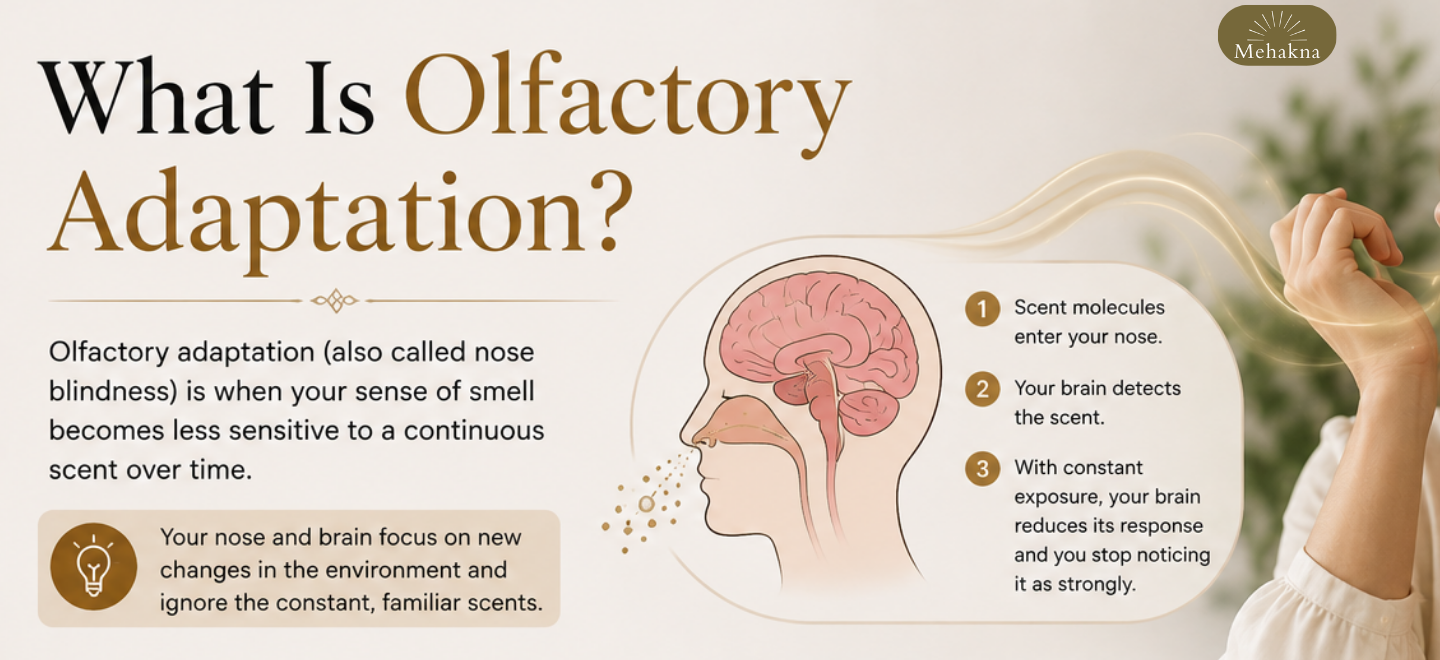
This natural process is called olfactory adaptation, sometimes referred to as nose blindness. It is one of the reasons you may stop noticing your own perfume even though people around you can still smell it.
What Is Olfactory Adaptation?
Our sense of smell is designed to detect changes in our environment. When your nose encounters the same scent continuously, your brain gradually becomes less responsive to it.
Think about walking into a room with a strong fragrance. When you first enter, you immediately notice the smell. After spending some time in the room, however, the fragrance seems much weaker.
The scent has not necessarily disappeared. Your brain has simply started filtering it out because it has become familiar.
The same thing happens with perfume.
When you apply your favorite fragrance to your skin, your nose receives those scent molecules repeatedly. Over time, your brain recognizes the fragrance as something familiar and reduces the amount of attention it gives to it.
This is why you may stop smelling your perfume while someone standing next to you can still notice it.
Why Does Your Brain Do This?
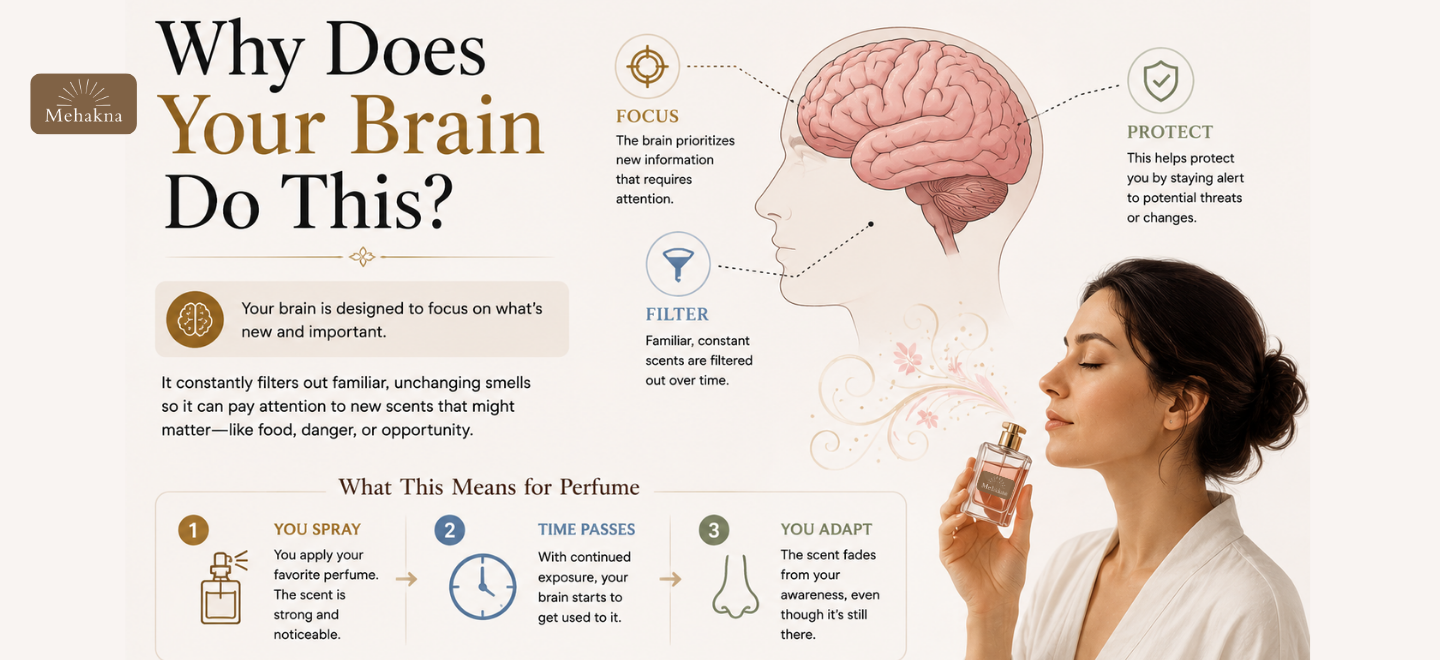
Your brain is constantly processing an enormous amount of information. Sounds, sights, smells, temperature, touch, and other sensations are being detected all the time.
If your brain paid equal attention to every familiar sensation, it would quickly become overwhelmed.
Olfactory adaptation helps your brain focus on what is new or potentially important.
For example, if you enter a room and smell freshly baked food, your attention immediately goes toward it. After several minutes, you may barely notice the smell anymore.
The same principle applies to fragrance.
Your perfume becomes part of your surrounding environment, so your brain gradually stops highlighting it.
Does This Mean Your Perfume Has Stopped Working?
Not necessarily.
One of the biggest mistakes people make is assuming that they need to keep spraying perfume simply because they cannot smell it anymore.
In many cases, other people may still be able to notice your fragrance.
This is especially true with perfumes that contain deeper, longer lasting fragrance notes such as woods, musk, amber, vanilla, and oud. These notes can remain on the skin or clothing for many hours, even when your own nose has become accustomed to them.
Your perception of the fragrance and the actual presence of the fragrance are not always the same thing.
That is why repeatedly spraying your perfume throughout the day may not always be necessary.
Why Can Other People Smell Your Perfume?
There is an important difference between smelling your own fragrance and smelling someone else’s fragrance.
When you wear a perfume, you are exposed to it continuously. The fragrance is always around you, particularly when it has been applied to areas close to your nose.
Another person encounters your fragrance differently.
They may walk into your scent trail, notice the fragrance as you move, or smell it when they come closer to you. Because the fragrance is new to their nose, their brain has not adapted to it in the same way.
This is why someone might compliment your perfume several hours after you stopped noticing it yourself.
Your Scent Can Still Have a Sillage
Sillage refers to the scented trail that a perfume can leave behind as the wearer moves.
Imagine someone wearing a beautiful fragrance walking past you. You may notice their perfume for a few seconds after they have passed.
The wearer may not notice that same effect because their nose has already adapted to their fragrance.
Sillage depends on several factors, including the fragrance composition, concentration, skin chemistry, temperature, humidity, and how much perfume has been applied.
A fragrance with strong projection and good longevity may continue to make an impression even when the person wearing it can no longer smell it clearly.
Why You Should Not Keep Overspraying
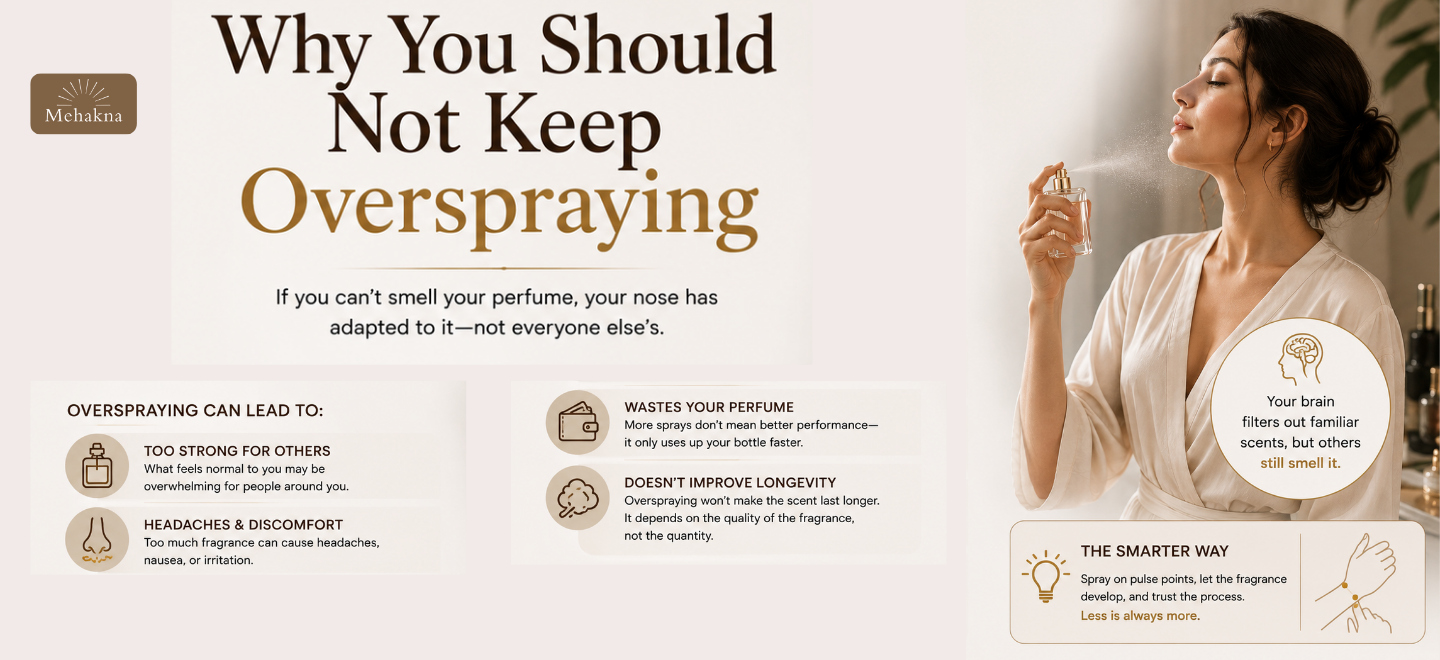
If you cannot smell your perfume, your first instinct might be to spray more.
But this can sometimes result in wearing far more fragrance than necessary.
Because your nose has adapted, you may keep increasing the amount while everyone around you experiences the fragrance at its full intensity.
Instead, give your perfume some time to develop.
If you are unsure about its performance, ask someone you trust whether they can still smell it. You can also smell your clothing later in the day because fabric can sometimes retain fragrance longer than skin.
How Can You Smell Your Perfume Again?
If you want to experience your fragrance more clearly, giving your nose a break can help.
Step outside for some fresh air or spend some time away from strong fragrances. Avoid continuously smelling your wrist throughout the day because repeated exposure can make adaptation happen more quickly.
You can also experience your perfume differently by smelling it from another area, such as clothing, rather than keeping your nose directly against your skin.
Most importantly, avoid judging your perfume’s performance only by how strongly you can smell it yourself.
The Beauty of Not Always Smelling Your Own Perfume
There is something interesting about wearing a fragrance that you eventually stop noticing.
A perfume does not necessarily need to announce itself to you every minute of the day. Sometimes, it becomes part of your personal presence.
You may stop noticing it, while the people around you continue to experience it.
That subtle fragrance trail can become part of how people remember you.

Final Thoughts
So, why can’t you smell your own scent?
The simple answer is that your nose and brain have adapted to it.
Olfactory adaptation is a completely natural process that helps your brain filter out familiar smells and focus on new information. It does not automatically mean your perfume has disappeared or stopped performing.
The next time you spray your favorite fragrance and think, “I can’t smell it anymore,” don’t immediately reach for the bottle.
There is a good chance your perfume is still there.
Your nose has simply decided it already knows the story.